THE MOST SHOCKING VOW IN THE BIBLE!
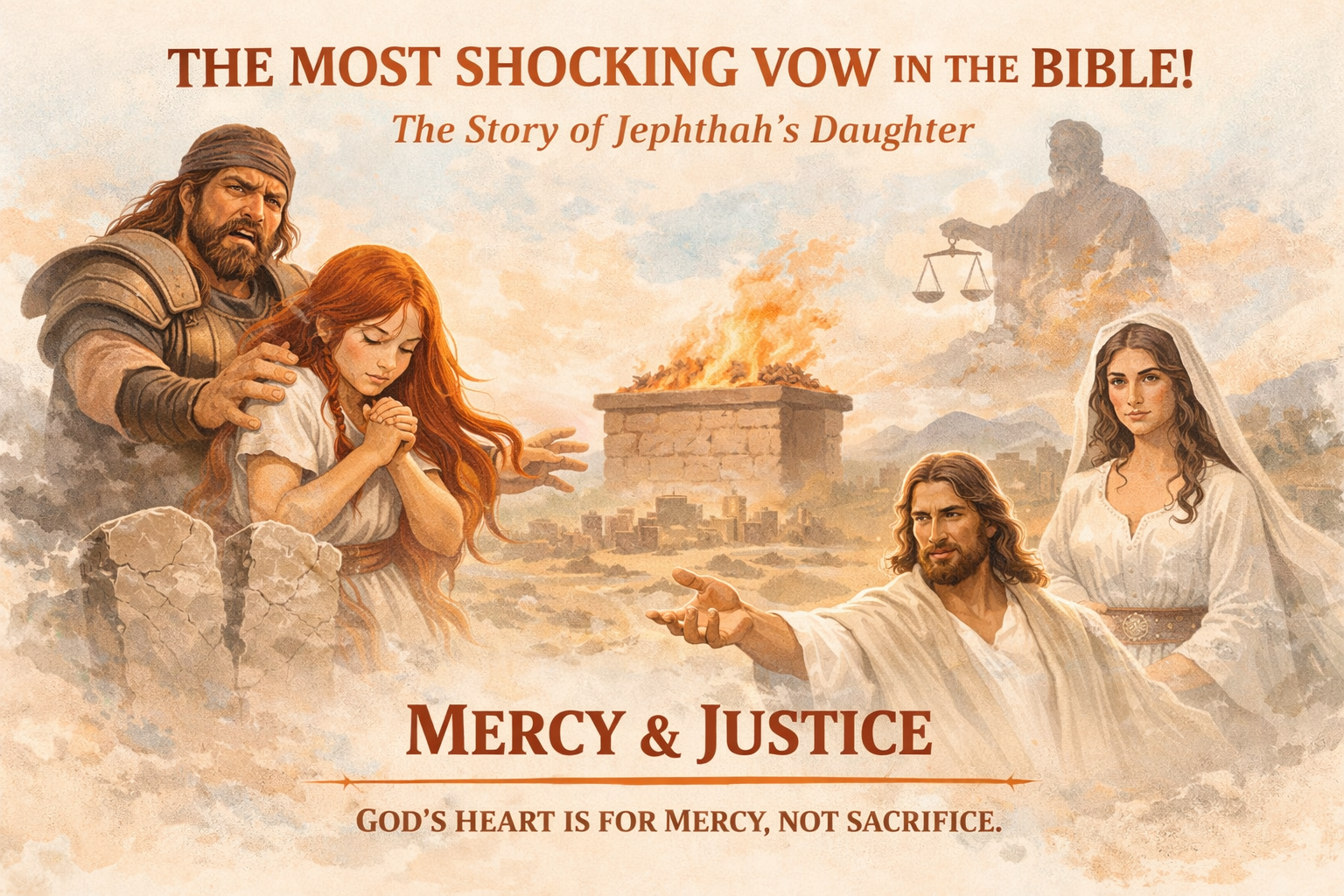
In the book of Judges, there’s a man named Jephthah who makes a vow to God: “Whatever comes out of the door of my house when I return in victory, I will offer to the Lord.”
When he comes home, it’s his only daughter who runs out to greet him. And he follows through on his vow.
Suddenly, we’re left with a haunting question: would God really want a life destroyed just to keep a promise?
Now, the Bible makes it very clear that child sacrifice is a grave sin, strictly forbidden. So what is the point of this story? When I was younger, I thought we were supposed to read it and say, “Wow, look at his dedication to God.” But as I studied more, I realized the story wants us to wrestle with the emotion it stirs. It wants us to sit in the tension.
God had made covenants — one with Adam, one with Israel.
With Adam (representing all mankind), the covenant said: “Anyone who sins will die.”
With Israel, the covenant said: “If you break it, you will be cursed and displaced from the land.”
Adam broke the covenant. Israel broke the covenant. We all broke the covenant.
If God keeps the covenant as written, the story ends with His children dying.
The story right before this one- the immediate context is - Israel has just broken the covenant again.
In the story, there is a repeated emphasis on her virginity, and it isn’t accidental. Throughout the prophets, Israel herself is called “the virgin daughter of Zion.”
When Jephthah’s daughter mourns her virginity — the loss of her future and fruitfulness — it mirrors Israel’s own story. God’s covenant people, meant to be fruitful and multiply, to be a microcosm representing a relationship with God to the world, instead face barrenness and exile under judgment. She isn’t just a tragic girl in history; she is a picture of Israel herself, cut off from life unless God provides a way for mercy to triumph.
But here’s the dilemma: if breaking the covenant doesn’t matter, then God becomes a covenant-breaker Himself. He would be unjust, unpredictable ans untrustworthy. The whole universe collapses if God can’t be counted on to keep His word.
So how can God uphold justice and still rescue life?
On Mount Sinai, right after the golden calf incident, Israel had already broken the covenant. According to the first covenant terms, they were doomed. But before rewriting the law, God adds something new — a strange little line: “I will have mercy on whom I will have mercy.” (Exodus 33:19)
This isn’t about predestination. It’s about God giving Himself the freedom to extend mercy within the covenant framework. Justice remains, but mercy is woven in.
And in the covenant with Adam, He does the same: the wages of sin is still death, but He takes on flesh, puts his own spirit in a man to take that death on Himself. Jesus, God in human flesh, keeps the covenant on our behalf. Justice is satisfied — but mercy triumphs.
The Bible says it plainly: “I desire mercy, not sacrifice.”
So the story of Jephthah’s daughter isn’t really about whether he should have let her die. It’s pointing us to the bigger question: Should God let His children die just because of a covenant He made? And the answer, revealed in Christ, is no, that to God the life of his children is more important- Mercy and Love will be the victor.
BIBLE VERSE JAR

Our bible verse jar is made of thickened glass, making it more sturdy.
Inspirational Verses. Our Bible prayer jar provides 96 selected verses covering a wide range of emotions and feelings. Whether you are looking for comfort, inspiration, or encouragement, pull a card from the Bible jar, soak up the wisdom of God and Jesus, and let these verses warm your heart and give you strength and confidence.
Promote Mindfulness and Gratitude.
Widely Used - Perfect Gift This Bible verse jar is a meaningful faith based gift.