How to Identify A True Prophet
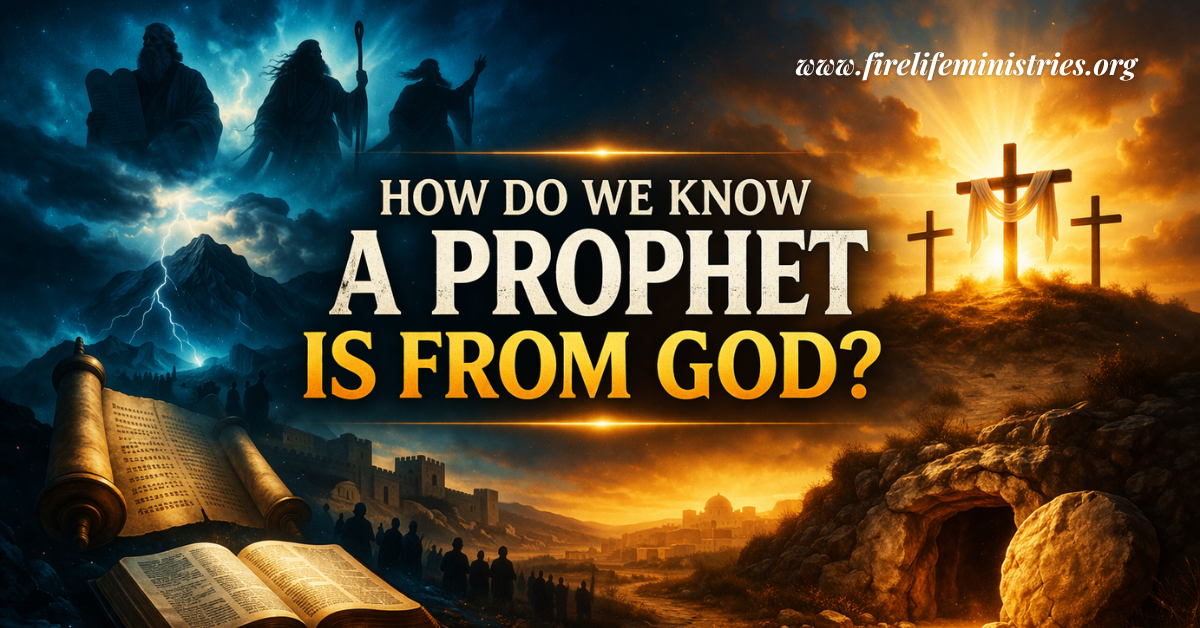
There have been many people throughout history who claimed to be prophets of God or said they had new revelations from Him.
So why do we believe Noah, Moses, Abraham, Elijah, Daniel, and Samuel when they said they were prophets—
but not others who claimed to have revelation from God, like the Gnostics or the writers of books that were not accepted into the Bible, such as the Gospel of Thomas?
It’s not just about who claimed it the loudest.
There were actually tests for true prophets:
Did what they said come true?
Noah proved he heard from God about building the ark—because the flood actually came.
Did their message lead people closer to God?
There were people in Pharaoh’s court who could perform signs, but they told Pharaoh he was a god and should be worshiped instead of the Creator.
Did their lives reflect God’s character?
Some so-called prophets encouraged people to worship other gods—directly contradicting what God had already revealed in the Ten Commandments.
Others promoted practices like temple prostitution or even child sacrifice—things completely opposed to God’s nature.
God had already revealed Himself as holy, just, and loving—not through a single prophet, but directly to an entire nation.
At Mount Sinai, not long after the Israelites were delivered from Egypt,
God spoke directly to the people—not through a prophet, but to about a million people at once.
Before He gave the Ten Commandments to Moses in written form,
He first spoke them out loud to the entire nation—with thunder, fire, smoke, and the sound of a trumpet.
The people heard His voice—and they were terrified.
They responded out loud, committing to obey.
But then they begged Moses:
“Do not let God speak to us, or we will die.” (Exodus 20:19)
From that point forward, God spoke through Moses—
not because He was hiding, but because the people asked for a mediator.
God made His nature and His commands unmistakably clear from the very beginning.
And that became the standard every future prophet had to align with.
This is the biggest indicator:
Did their message align with what God had already revealed?
If you have dozens of prophets all pointing to the same God, the same truth, the same unfolding story—
and then one person shows up saying something completely different—
that’s a major red flag.
Because God doesn’t contradict Himself.
He builds.
Now, you might be thinking:
Didn’t Jesus change everything? Didn’t He go against what came before?
Surprisingly, the answer is no.
The “new covenant” He brought had already been spoken about by earlier prophets.
Jesus Himself said:
“I did not come to abolish the Law… but to fulfill it.”
And the way He fulfilled what was written before Him is remarkable.
Today—or the day I’m recording this—is Passover.
And this one event alone reveals something incredible.
Passover isn’t just history.
It’s a divinely designed picture—written into Israel’s calendar over 1,400 years before Jesus.
And when you see how Jesus fulfills it—with precision, not coincidence—
it changes everything.
Let’s go back to the first Passover.
In Exodus 12, God told the Israelites to sacrifice a spotless lamb,
take its blood, and place it on their doorposts.
That night, judgment passed through Egypt—
but every house covered by the blood was spared.
The blood of the lamb saved them from death.
Now fast-forward.
Paul writes:
“Christ, our Passover lamb, has been sacrificed.” (1 Corinthians 5:7)
Jesus didn’t just relate to Passover—
He fulfilled it.
Just as the lamb’s blood covered the Israelites,
Christ’s blood covers us—shielding us from judgment and giving us life.
And it goes even deeper.
The Passover meal (the Seder) includes symbolic elements:
Unleavened bread
Bitter herbs
Salt water
Greens
Each one tells a story.
And the early Church saw Jesus in all of it:
The Lamb who was slain
The bread, broken and shared
The bitterness of suffering
The blood poured out
Even the greens dipped in salt water—symbolizing life through sorrow
From the beginning, the idea of new life—being “born again”—was already there.
And the parallels don’t stop.
When Jesus was crucified, the land went dark.
Matthew 27:45 says darkness covered the land from noon to 3 p.m.
That wasn’t random.
Amos 8:9 prophesied:
“I will make the sun go down at noon and darken the earth in broad daylight.”
And then:
“It will be like mourning for an only son.”
That’s exactly what happened.
Even Judas’ betrayal was foretold:
Psalm 41:9:
“My close friend… has turned against me.”
Zechariah 11:12–13:
Thirty pieces of silver… thrown to the potter.
Psalm 109:8:
“May another take his place.”
All fulfilled in detail.
And then there’s Isaiah 53:
“He was pierced for our transgressions…
led like a lamb to the slaughter…”
Written 700 years before Jesus.
Even Abraham and Isaac point forward.
God tells Abraham:
“Take your son, your only son, whom you love…”
A clear picture of the Father offering His Son.
But God stops Abraham—and provides a ram instead.
A substitution.
Another preview of what was coming.
None of this was random.
It was one story—woven across centuries—fulfilled in one moment.
Scholars estimate Jesus fulfilled over 300 prophecies.
And the odds of just 8 being fulfilled by one person?
Less than 1 in 10¹⁷.
Jesus wasn’t just another voice claiming a new revelation.
He was the fulfillment of a consistent story—
written by many voices, across generations, all pointing to Him.
That’s very different from someone claiming something new
with no foundation, no alignment, and no confirmation.
Now, there’s also a debate around how exactly Jesus saves.
Two main views:
Penal Substitution — Jesus took the punishment we deserved.
Christus Victor — Jesus defeated sin, death, and the powers of darkness.
So which is it?
Both.
He died for us—
and He defeated what held us captive.
Some argue Passover wasn’t about atonement—because the lamb was eaten,
while atonement sacrifices were not.
But that misses the bigger picture.
Jesus didn’t fulfill just one sacrifice.
He fulfilled them all:
The burnt offering
The sin offering
The guilt offering
The peace offering
Even the red heifer—sacrificed outside the camp
Jesus was crucified outside the city—making us clean.
Every shadow.
Every symbol.
Every sacrifice.
Fulfilled in one moment—on one cross.
In the original Passover, the blood marked the door.
Death passed over.
But Jesus didn’t just fulfill the lamb—
He said:
“I am the door.” (John 10:9)
He doesn’t just save you from death.
He opens the way into life—
into the kingdom of God.
So now the question is:
Will you trust the blood that saves?
Will you walk through the door He opened for you?
BIBLE VERSE JAR

Our bible verse jar is made of thickened glass, making it more sturdy.
Inspirational Verses. Our Bible prayer jar provides 96 selected verses covering a wide range of emotions and feelings. Whether you are looking for comfort, inspiration, or encouragement, pull a card from the Bible jar, soak up the wisdom of God and Jesus, and let these verses warm your heart and give you strength and confidence.
Promote Mindfulness and Gratitude.
Widely Used - Perfect Gift This Bible verse jar is a meaningful faith based gift.